A fast tour through the history of Gorinchem
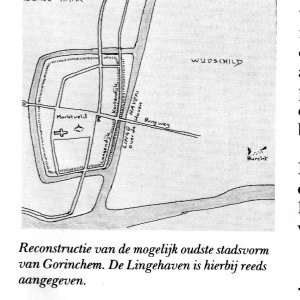
This is the oldest shape of Gorinchem in the early middle ages.
The town walls existed of earth with wooden palisades.
In 1267 they started to build a big castle on the east side of Gorinchem, close to the river Merwede.
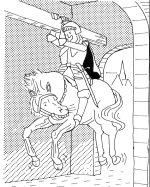
The story goo's, that Jan I of Arkel, called "The strong one" lifted himself and his horse of the ground by pulling with his arms on the wooden beams in the town gates.
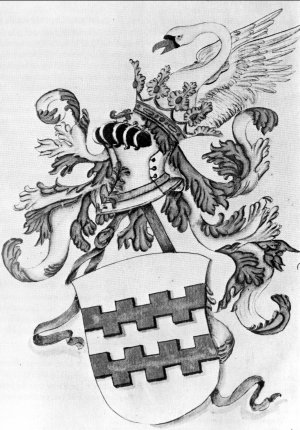
The picture on the left shows the coat of arms of the lords of Arkel.
In the 14th century the lords of Arkel fortified Gorinchem also, with brick town walls, towers and town gate buildings.
In 1382 Gorinchem was officially grounded as a town, what meant that the town could have its own government, law, taxes and money.
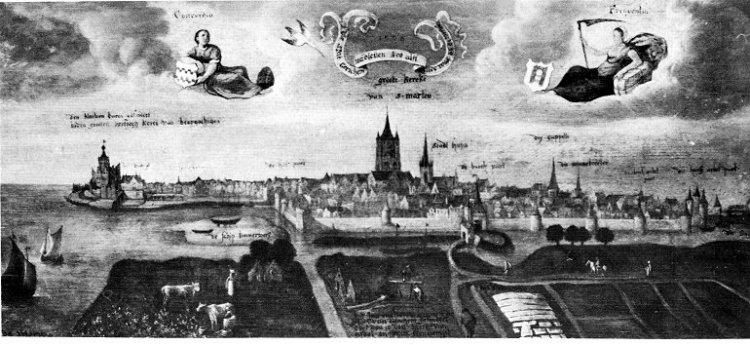
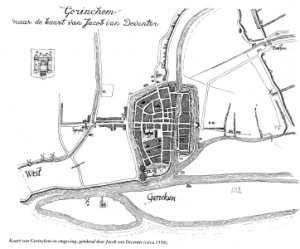
This is the layout of Gorinchem in the middle ages, with the town walls of stone, equipped with 7 gates and 23 towers including castle The Blue Tower "Kasteel de Blauwe Toren".
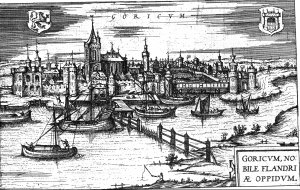
This is an engraving of 1580, looking at Gorinchem from the south, this engraving gives an impression of the middle ages town walls.
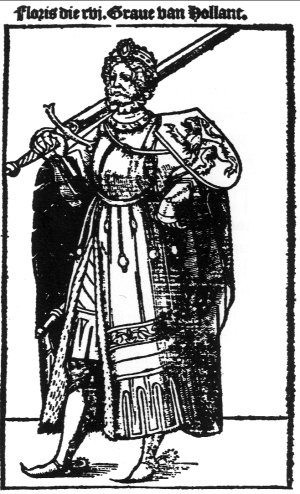
In that time it was custom to formally give possessions to the count, which in return was lend out by the count to the lords.
The count also would give the lords then certain privileges, such as the right to collect taxes and toll in within the lend property.
Also the lords men got toll freedom for a certain area.
The lords of Arkel became very important knights in the council of the count.
Their position improved up to 1354, then lord Jan van Arkel came into conflict with
Albrecht van Beijeren, the brother of then count Willem V, who was taking power after
count Willem V lost his mind.
Division was growing in the council, two party's of lords arose, the "Hoeken" and the "Kabeljauwen".
In 1401
an army of joint forces of the count of Holland and the bishop of Utrecht together with
British and German mercenary troops advanced on Jan van Arkels territory.This big army was
defeated by Jan van Arkel and his troops in a field battle at the village Noordeloos.
After that Jan van Arkels troops retreated into Gorinchem.
The retreated other force regrouped and besieged Gorinchem for a long period, which ended
in a treaty between both party's.
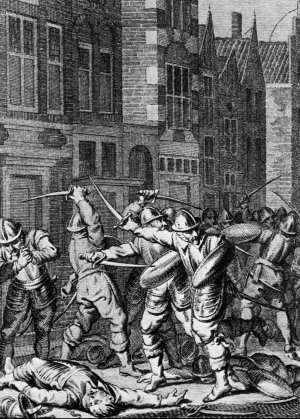
In 1412 Gorinchem got into the hands of count Willem VI, in 1417 Willem van Arkel tried to get Gorinchem back, he and his troops succeeded in getting into the town, but during fears fighting in the streets Willem van Arkel was killed. This ended the period of the lords of Arkel.